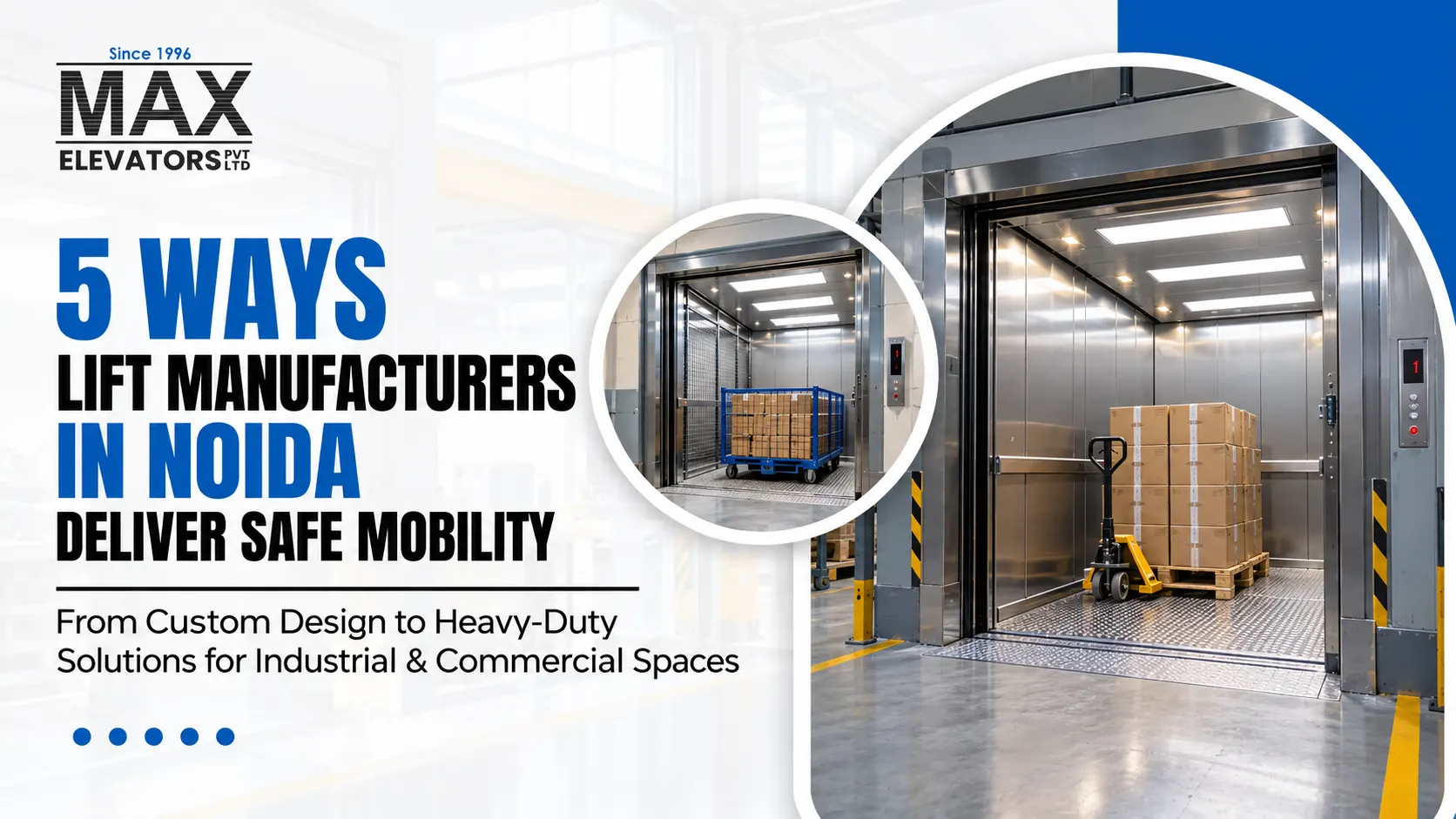
When factories, warehouses, commercial buildings, and industrial facilities in Noida need vertical transportation, choosing the right lift involves more than capacity alone. Available space, building structure, number of floors, working environment, and day-to-day usage can all influence the final lift configuration.
Experienced lift manufacturers in Noida can assess these requirements and recommend a solution suited to the building and its application. A warehouse may need a high-capacity goods lift, while a manufacturing unit may require a factory or material lift designed around its workflow.
Max Elevators has been manufacturing lift solutions since 1996, with two manufacturing facilities in Delhi covering 18,000 sq. ft. and 1,700+ installed units across different sectors. So, what should businesses look for when evaluating lift manufacturers in Noida? Here are five factors that can help guide the decision.
1 - Custom Lift Design Starts With the Building and Its Requirements
A lift should not be selected simply by looking at its capacity or appearance.
Every industrial and commercial site has different requirements. The available shaft space, number of floors, cabin dimensions, loading requirements, power supply, building structure, and working environment can all influence the appropriate lift configuration.
Experienced lift manufacturers in Noida can begin by understanding these practical requirements before recommending a suitable solution.
For example, Max Elevators provides customisation across multiple parameters, including:
- Lift capacity
- Cabin width, depth and height
- Number of landings
- Building height
- Available space
- Pit requirements
- Machine-room-less configurations
- Lift shaft location
- RCC, brick or steel support structures
- Gate configurations
- Cabin interiors
- Flooring
- Power supply
- Guiding system
- Working environment
- Flameproof lift requirements
Max Elevators states that its lifts can be customised across 46 parameters, allowing businesses to develop a configuration around their operational requirements rather than trying to force a standard design into an unsuitable space.
Capacity is another important consideration. The company's stated lift capacity range is 500 kg to 10,000 kg, depending on the application and configuration.
Why does customised design matter?
Consider a warehouse where heavy materials need to travel between two or more levels. The lift needs to accommodate the required load while also fitting the available shaft and landing arrangement.
Similarly, a manufacturing facility may have limited space for a conventional lift installation. Options such as a nearly no-pit configuration or machine-room-less arrangement may be considered where appropriate to the site requirements.
The goal is simple: design the lift around the application, rather than designing the application around the lift.
2 - Goods and Material Lifts Help Move Heavy Loads in Controlled Conditions
Moving heavy goods manually between floors can create unnecessary operational challenges for factories, warehouses and industrial facilities.
A purpose-designed goods lift in Noida can provide a dedicated vertical transportation solution for materials, equipment and other loads.
This is particularly relevant for:
- Manufacturing units
- Warehouses
- Distribution facilities
- Industrial plants
- Commercial complexes
- Multi-level factories
- Storage facilities
Max Elevators manufactures goods lifts, material lifts, industrial lifts, factory lifts and warehouse lifts for industrial and commercial applications. The appropriate configuration depends on factors such as load capacity, cabin size, number of floors, shaft arrangement, and operating environment.
For example, the company provides stated capacity options from 500 kg to 10,000 kg. Cabin dimensions can also be customised, with the company stating that cabins up to 22 ft in width and depth have already been supplied.
How can a goods lift support safer material movement?
A dedicated material-handling lift creates a defined route for transporting goods vertically. Instead of relying on unsuitable transportation methods, businesses can consider a lift specifically designed around the required load and building configuration.
The lift's gates, cabin dimensions, guiding arrangement and structural support can also be configured according to the application.
For Noida's industrial and commercial facilities, this makes selecting an experienced goods lift manufacturer an important part of the planning process.
3 - Lift Manufacturing Combines Engineering With Quality Control
The manufacturing stage is another important part of delivering a dependable lift.
A lift is made up of multiple components that need to work together as one system. Its design therefore needs to account for the intended application, dimensions, load and installation conditions.
Max Elevators states that its lifts are designed and developed using AutoCAD and evaluated through more than 1,500 formulas as part of its design approach.
The company also operates two manufacturing facilities covering a combined area of 18,000 sq. ft. in Delhi.
Why does manufacturing capability matter?
A manufacturer with its own established production infrastructure can work around application-specific requirements rather than relying only on off-the-shelf configurations.
This can become particularly important when a project requires changes to:
- Cabin dimensions
- Capacity
- Gate type
- Cabin materials
- Flooring
- Shaft structure
- Power supply
- Guiding tracks
- Working environment
For example, Max Elevators offers cabin options using materials such as powder-coated walls and stainless steel, with stated options including SS 304 and SS 316. Flooring can also be configured using options such as plain MS, chequered, stainless steel or aluminium, depending on requirements. The emphasis should remain on selecting materials and configurations that are appropriate for the intended application.
4 - Different Working Environments Require Different Lift Configurations
Not every industrial facility operates under the same conditions. A standard lift configuration may not be suitable for every environment. Factories can involve dust, specialised hygiene requirements, acidic materials or other operating conditions that need to be considered during lift selection.
This is why experienced lift manufacturers in Noida need to understand the environment in which the lift will operate.
Max Elevators lists configurations for different working environments, including:
- Normal operating requirements
- Hygienic applications
- Hazardous acidic-material environments
- Dusty working environments
- Flameproof lift applications
What should businesses consider?
Before selecting an industrial or factory lift, a business should identify the actual conditions around the installation.
Questions may include:
- 1 - What type of material will the lift carry?
- 2 - How much load needs to be transported?
- 3 - How many floors need to be served?
- 4 - What space is available?
- 5 - What type of working environment will the lift operate in?
Addressing these questions at the design stage can help businesses select a more appropriate solution.
5 - Installation and After-Sales Support Completes the Lift Solution
Manufacturing a lift is only one part of the process. A lift also needs to be installed according to the project requirements and supported after installation. For businesses, dependable service can be especially important because a lift may form an essential part of daily material or people movement.
Max Elevators describes itself as a complete lift and elevator solution provider covering manufacturing, installation, and maintenance.
The company has been operating since 1996 and states that it has installed more than 1,700 lifts across a variety of sectors.
Why does after-sales service matter?
Industrial facilities often depend on equipment for routine operations. When vertical transportation becomes part of a production or logistics workflow, maintenance and service become important considerations alongside the initial purchase.
Max Elevators states that its approach includes reducing maintenance requirements while providing after-sales service.
A business evaluating a manufacturer can therefore look beyond the initial quotation and ask:
- Who will handle installation?
- What type of maintenance support is available?
- How will service requirements be managed?
- Is the manufacturer experienced with the intended lift type?
- Can the manufacturer support customised configurations?
- Does the manufacturer have an established production and service infrastructure?
These questions can help businesses evaluate the complete lifecycle of a lift rather than focusing only on the purchase price.
What Makes a Reliable Lift Manufacturer in Noida?
This is where the manufacturer's engineering, manufacturing, and service capabilities become important.
Max Elevators has been manufacturing lift solutions since 1996 and operates two manufacturing facilities in Delhi across 18,000 sq. ft. The company states that it has installed 1,700+ lifts across different sectors.
Its product range includes:
- Industrial Lift
- Goods Lift
- Goods Passenger Lift
- Factory Lift
- Material Lift
- Warehouse Lift
- Car Lift
- Dumbwaiter
- Flameproof Lift
- Commercial Lift
- Loading Lift
- Structure Lift
- Passenger Lift
The company also provides customised configurations based on capacity, dimensions, landings, shaft structure, gates, interiors, power supply, and operating environment.
For businesses in Noida, this Delhi NCR-based manufacturing capability provides an option to discuss lift requirements with a manufacturer serving the wider NCR market.
Looking for Lift Manufacturers in Noida for Your Project?
If your factory, warehouse, commercial building or industrial facility in Noida needs a customised lift solution, discuss your requirements with Max Elevators.
Choose the lift based on your space, load, and application—not simply on a standard model. Discuss your project requirements with Max Elevators to explore a suitable configuration.
Choose the lift based on your space, load, and application; not simply on a standard model.
Max Elevators has been manufacturing customised lift solutions since 1996.
Frequently Asked Questions
1 What if my factory has limited space for lift installation?
A customised lift can be designed around the available space, including nearly no-pit and MRL configurations where suitable.
2 Can lift manufacturers in Noida customise cabin dimensions?
Yes. Cabin dimensions can be customised according to the available space and material-handling requirements.
3 What lift is suitable for dusty industrial environments?
The lift should be specified according to the working environment. Max Elevators offers solutions for dusty, hygienic, acidic, and specialised industrial conditions.
4 What if my building does not have space for a machine room?
An MRL (machine-room-less) lift may be considered where suitable for the building and application.
5 How many floors can an industrial lift serve?
Max Elevators states that its customised configurations can serve 2 to 10 floors, depending on the project requirements.
6 Can a factory lift be customised for a specific production process?
Yes. Factors such as capacity, cabin size, gates, landings, power supply, and working environment can be considered during customisation.
Looking for Custom Lift Solutions?
Get in touch with Max Elevator engineers for expert consultation and quotes.


