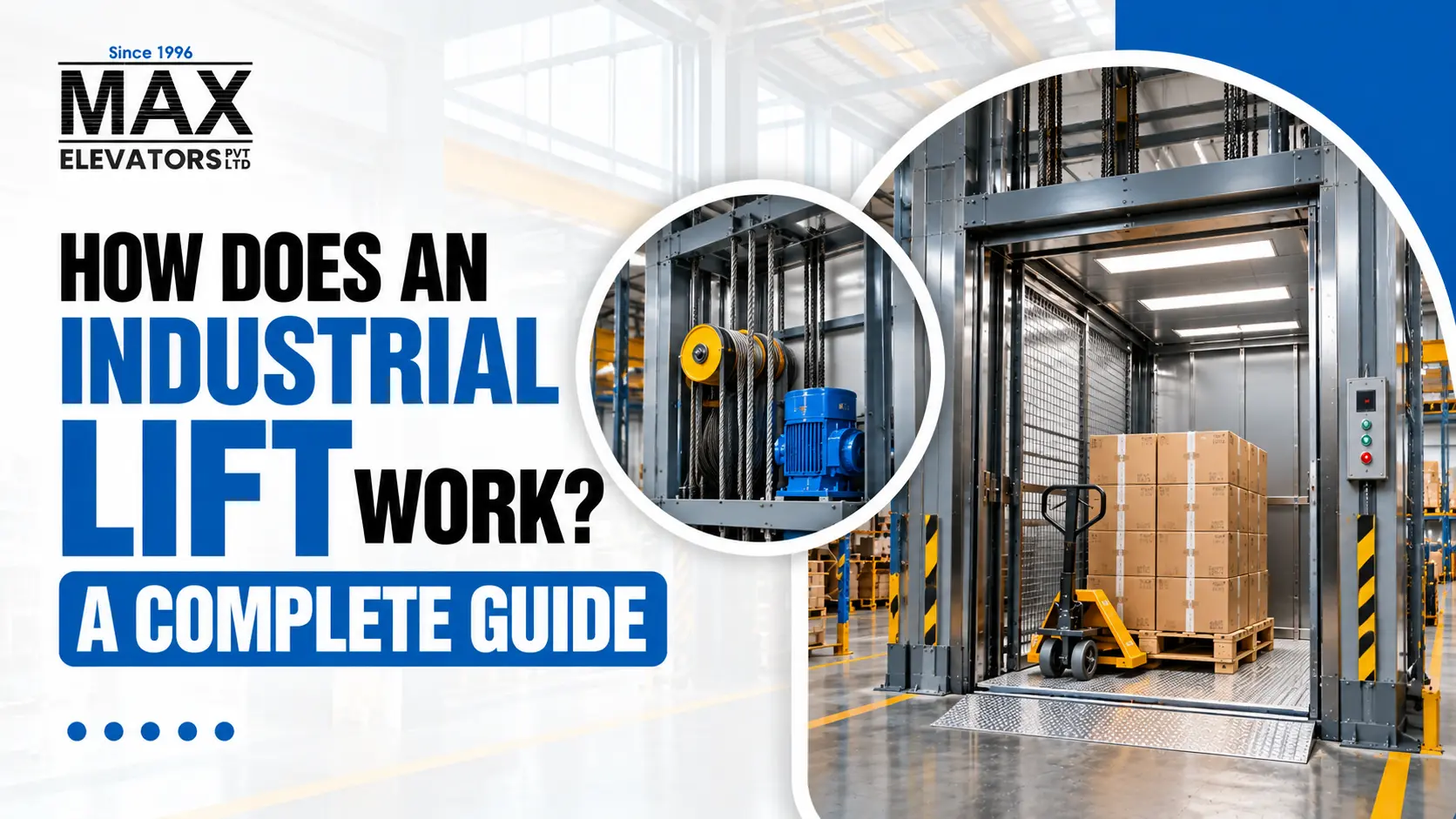
Moving heavy materials between floors can slow down production, increase manual handling, and create unnecessary workplace risks. An industrial lift helps businesses move goods, equipment, and materials vertically in a controlled manner, making it easier to manage operations in factories, warehouses, and manufacturing facilities.
How does an industrial lift work? An industrial lift uses a powered mechanical system, such as a hydraulic mechanism or an electric motor-driven traction system, to raise and lower a platform or lift cabin. Its controls regulate movement, while guide rails, brakes, interlocks, and other safety devices help ensure controlled operation, depending on the lift design.
Understanding the industrial lift working principle helps businesses choose equipment that matches their load requirements, building layout and daily material-handling needs.
What Is an Industrial Lift?
An industrial lift is a mechanical lifting system designed to transport materials, equipment, and goods between different heights. These lifts are commonly installed in factories, warehouses, distribution centres, workshops, and commercial facilities.
Unlike passenger elevators, industrial lifts are generally designed around specific material-handling requirements, including load capacity, platform dimensions, lifting height, and operating frequency.
Common applications include:
- Moving raw materials between production floors.
- Transporting finished goods in warehouses.
- Loading and unloading materials.
- Shifting machinery and industrial equipment.
- Moving pallets, cartons, and heavy components.
The primary purpose is to make vertical material handling more efficient while reducing dependence on manual lifting.
Read More: 5 Ways Lift Manufacturers in Noida Deliver Safe Mobility
How Does an Industrial Lift Work? Step-by-Step Process
The exact mechanism depends on the lift type. However, most powered industrial lifts follow a similar operating sequence.
1. Loading the Material
The operator places the goods on the lift platform or inside the cabin. The load must remain within the rated capacity and be positioned according to the manufacturer's instructions.
Unevenly distributed or unsecured loads can affect stability and create operational hazards.
2. Activating the Control System
The operator selects the required floor or movement direction using the designated controls. The control system checks the operating conditions and, where applicable, verifies that doors, gates, and safety interlocks are correctly positioned.
The lift should not operate when a required safety condition has not been met.
3. Powering the Lifting Mechanism
The drive system converts electrical energy into the movement needed to raise the load.
In a hydraulic industrial lift, an electric motor drives a pump that sends pressurised hydraulic fluid into a cylinder. The cylinder's piston extends and raises the platform.
In an electric traction lift, a motor rotates a drive sheave connected to suspension ropes or other specified lifting components. The movement of these components raises or lowers the lift car.
4. Moving Along the Guide System
As the lift travels, its platform or cabin follows the designed travel path. Guide rails or other guiding arrangements help maintain alignment and control unwanted movement.
The lift's control system regulates travel according to its design, including speed, stopping position, and floor-level accuracy.
5. Stopping at the Required Level
When the lift reaches the selected floor, its control system brings it to a stop. The platform must reach the intended loading level before the operator begins unloading.
Door interlocks and other protective arrangements help prevent unsafe access during movement, where fitted and required by the design.
6. Lowering the Platform
The lowering mechanism depends on the drive system. A hydraulic lift typically opens a controlled valve to allow fluid to return to the reservoir, allowing the platform to descend under its load and the system's designed forces.
An electric traction lift lowers by operating its motor and drive mechanism in the appropriate direction.
The cycle can then be repeated for the next load.
Read More: Hospital Stretcher Lift Buying Guide: Types, Size, Dimensions & Cost
How a Hydraulic Lift Raises and Lowers Loads
When the operator activates the upward control, the motor drives the pump, which supplies hydraulic oil to the cylinder. Pressure moves the piston, raising the connected platform.
When the operator selects the downward direction, the hydraulic control valve regulates the return of oil to the reservoir. The platform descends in a controlled manner under the forces acting on the system.
This mechanism can be useful for heavy-duty lifting applications, particularly where the travel height and building layout suit a hydraulic arrangement. The final design must account for load capacity, cylinder configuration, lifting height, duty cycle, and installation space.
Hydraulic vs Electric Industrial Lifts: What Is the Difference?
Here are the core differences:
Feature
Hydraulic Lift
Electric Traction Lift
| How it lifts | Fluid pressure pushes a piston | Motor-driven ropes move the lift |
| Power system | Pump, cylinder and valves | Motor, sheave and suspension ropes |
| Counterweight | Usually not required | Common in traction designs |
| Installation needs | Space for hydraulic equipment | Space for drive and suspension systems |
| Best suited to | Applications suited to hydraulic lifting | Applications suited to traction systems |
| Maintenance focus | Oil, seals, valves and cylinders | Motor, ropes, brakes and drive |
Which one should you choose? It depends on your load capacity, lifting height, operating frequency, available space, and maintenance requirements. A site assessment helps identify the right system for your facility.
Which Safety Features Matter in an Industrial Lift?
An industrial lift should be designed around its intended load, environment, and operating conditions. Appropriate safety equipment helps reduce risks during loading, travel, and unloading.
Important features to evaluate include:
- Overload protection
- Door and gate interlocks
- Limit switches
- Emergency stop
- Braking and load-holding arrangements
- Guiding and structural components
- Emergency procedures
The exact safety devices vary by lift type and application. Equipment selection, installation, inspections, and servicing should follow applicable regulations, manufacturer instructions, and the system's approved design.
Operators should never exceed the rated capacity, bypass safety interlocks, or enter a lift shaft to recover a load.
How Do You Choose the Right Industrial Lift for Your Business?
Before selecting an industrial lift, assess these six factors:
- Load capacity: Calculate the maximum expected load, including pallets, containers, and any associated handling equipment.
- Platform dimensions: Check the size, shape and loading orientation of the goods.
- Lifting height: Establish the vertical distance and number of stopping levels.
- Operating frequency: Estimate how many trips the lift must complete during a typical shift.
- Available space: Evaluate the shaft or platform area, pit requirements, headroom, access points, and structural support.
- Safety and environment: Identify requirements arising from dust, moisture, temperature, hazardous materials, or restricted access.
A lift that meets the load requirement but cannot accommodate the goods, building layout, or required operating cycle may create bottlenecks rather than solve them.
Why Choose an Industrial Lift Manufacturer in Delhi?
Selecting an experienced Industrial Lift Manufacturer in Delhi can help businesses identify a lifting solution suited to their operational needs.
A reliable manufacturer should be able to discuss load requirements, lifting height, platform dimensions, operating conditions, installation constraints, and maintenance expectations.
Before making a decision, ask the manufacturer about:
- Available lift types and load capacities.
- Customisation options for your facility.
- Safety features and applicable compliance requirements.
- Installation and commissioning support.
- Preventive maintenance and after-sales service.
- Warranty coverage and availability of replacement parts.
Do not compare suppliers on price alone. The equipment's suitability, build quality, safety provisions, and long-term maintenance requirements are equally important.
Final Verdict
Industrial lifts play an important role in modern manufacturing, warehousing, and material-handling operations. They use hydraulic, electric, or other engineered lifting mechanisms to transport goods between different levels efficiently.
Understanding how these systems work, which components they use, and what factors influence their selection can help you make a more informed purchasing decision.
If your business needs a reliable material-handling solution, consult an experienced
Industrial Lift Manufacturer in Delhi to discuss your load capacity, lifting height, platform dimensions, and site requirements.
Are you planning to install an industrial lift at your facility? Share your requirements or questions in the comments, and share this guide with anyone looking to improve their material-handling operations.
Frequently Asked Questions
1. Which industrial lift is best for moving heavy materials between floors?
The right lift depends on the load weight, platform size, lifting height, and frequency of use. A manufacturer can recommend a suitable hydraulic or electric system based on your site requirements.
2. How can I prevent industrial lift breakdowns in factories?
Schedule preventive maintenance, inspect critical components, avoid overloading, and address unusual noises, fluid leaks, or irregular movement promptly.
3. Can an industrial lift be installed in a building with limited space?
Yes, some lift configurations can accommodate space constraints. The available shaft area, pit depth, headroom, travel height, and structural conditions must be assessed before selecting a design.
4. What should I do if an industrial lift jerks or moves unevenly?
Stop operation, secure the area, and arrange a technical inspection. Uneven movement may indicate a mechanical, hydraulic, electrical, or control-system issue that requires professional diagnosis.
5. How can I reduce loading and unloading delays with an industrial lift?
Choose a suitable platform size, align loading points with the workflow, and assess travel time, floor access, and daily trip volume. The lift should be designed around the facility's material-handling process.
6. What information is needed to get an industrial lift quotation?
Share the required load capacity, lifting height, number of stops, platform dimensions, building layout, and intended application. These details help the manufacturer assess the appropriate configuration and installation requirements.
Looking for Custom Lift Solutions?
Get in touch with Max Elevator engineers for expert consultation and quotes.


