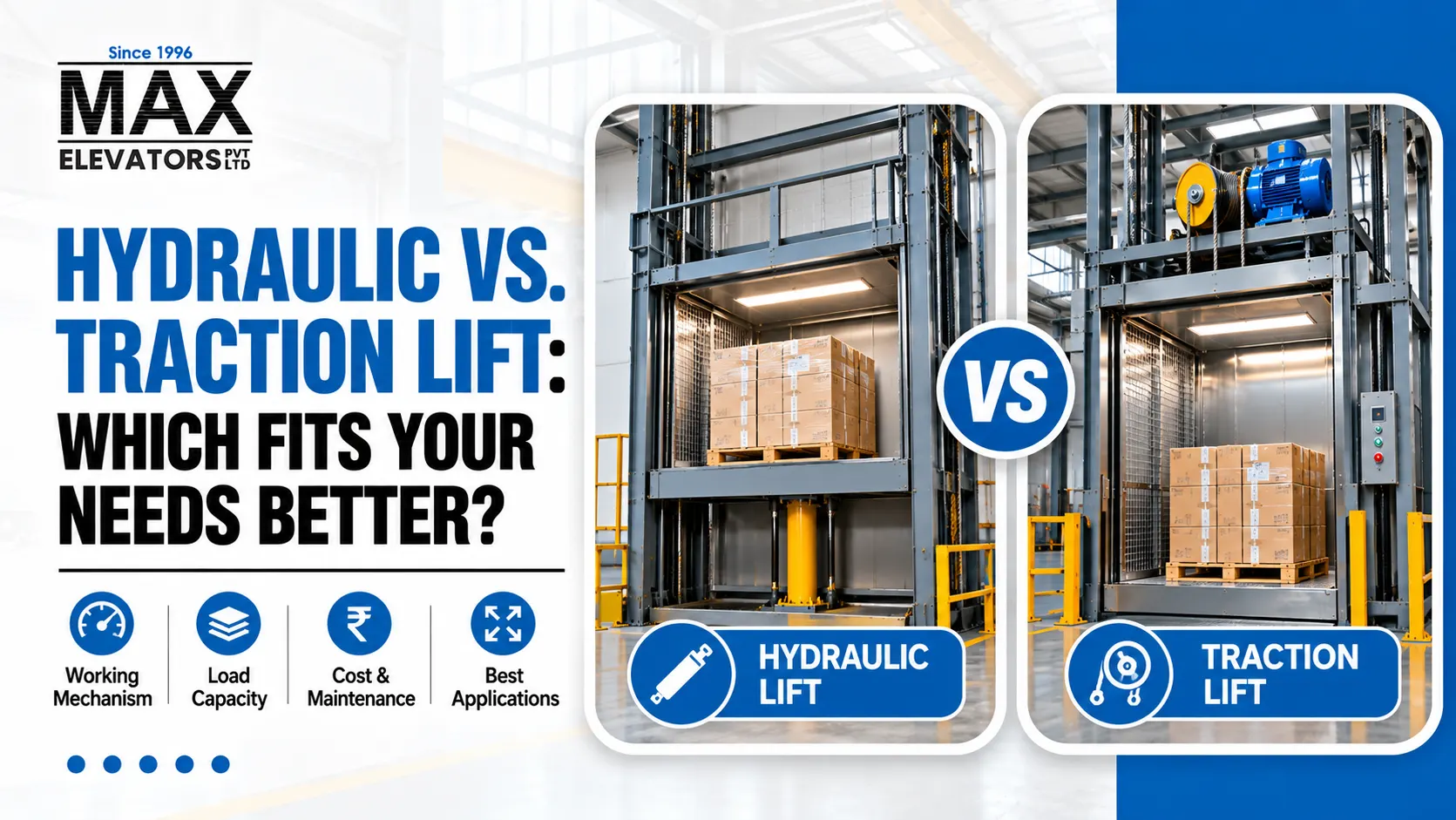
Hydraulic or traction lift? Discover the key differences in speed, load capacity, cost, and performance. Choose the right lift for your building’s needs!
You have a warehouse full of heavy and delicate materials which are required to move floor to floor. All of a sudden, your lift gets overloaded and fails to handle the operation.
And your entire workflow stops. As a result, you will bear the expenses and a damaged reputation.
That’s why the right lift can make or break your manufacturing unit. From lift type to its load capacity and price, you need to consider it all.
Now, the question: Which type of lift should you invest in?
There are two options: Hydraulic lifts and Traction lifts.
Both move goods as well as passengers in vertical flow. But their functionality, such as mechanisms, speed, energy consumption and installation requirements differ.
So, which one is right for your factory, warehouse, or commercial building?
Let's look at the key differences.
What Is a Hydraulic Lift?
A hydraulic lift is a type of lift that applies pressurised fluid to elevate and lower its platform.
How does it work?
- A hydraulic pump is meant to push fluid into a cylinder.
- Then, the pressure moves a piston upwards.
- The piston raises the lift platform.
- During going down, control valves release the fluid, zero force in lowering it.
Key advantages
- Perfect for various heavy-duty, low-rise applications.
- Provides controlled lifting and lowering.
- Can be installed for specific space and installation needs.
- Works well where high operating speeds are not important.
Things to consider
- Generally operates at lower speeds in comparison to traction lifts.
- Conventional systems consume energy during upward travel.
- Needs regular inspection of hydraulic fluid, seals, valves, and pumps.
- Suitable space is a must for hydraulic equipment.
Defining Traction Lift
Talking about traction lift, it consists of an electric motor, suspension ropes or belts, pulleys, and a counterweight to move its platform.
How does it work?
- Needs an electric motor to rotate a drive sheave.
- Sheave moves the suspension ropes or belts.
- Platform travels vertically.
- A counterweight is required to balance part of the cabin's weight.
Key advantages
- Higher operating speeds for general use.
- Best for greater travel heights.
- Counterweight systems can lead to high energy efficiency.
- Can be found in geared, gearless, and machine-room-less (MRL) configurations.
- Used for buildings with frequent lift usage.
Things to consider
Look for proper shaft and overhead clearance.
- Requires suitable arrangements for machinery and suspension components.
- Installation costs depend on the building and selected configuration.
- Regular inspection of ropes or belts, brakes, motor, and sheaves.
Hydraulic Lift vs. Traction Lift: Key Differences
Here is a quick comparison to help you understand which system may suit your requirements.
Factor
Hydraulic Lift
Traction Lift
| Working mechanism | Hydraulic pressure and piston | Motor, ropes or belts and counterweight |
| Speed | Generally slower | Faster |
| Building suitability | Low-rise | From Low-rise to high-rise |
| Load handling | Best for many heavy-duty applications | Handles heavy loads with perfect design |
| Energy consumption | Takes power to pump fluid during upward travel | Counterweight leads to energy efficiency |
| Installation | Needs hydraulic equipment | Needs traction machinery and suspension system |
| Maintenance | Fluid, valves, seals and pump | Ropes or belts, brakes, sheaves and motor |
| Travel distance | Generally shorter | Suitable for longer travel |
Actual performance, costs and suitability depend on the lift design, building conditions and usage.
Which Lift Is Better for Your Industrial Application?
The right lift which you look for depends on what you need to move, how often you use it, and how many floors it needs to cover.
1. Factories and Manufacturing Units
Your requirement: Transporting raw materials, machine parts, and final products between production floors.
- Hydraulic lift: Worth considering for low-rise factories with heavy-load needs.
- Traction lift: May suit multi-storey facilities with longer travel distances and frequent operations.
2. Warehouses and Distribution Centres
Your requirement: Moving pallets, cartons and inventory throughout the day.
- Hydraulic lift: Can suit heavy-load transportation over shorter distances.
- Traction lift: Preferred for longer travel and frequent movement between floors.
3. Commercial Buildings
Your requirement: Manage regular passenger movement in offices, hotels, and commercial complexes.
- Hydraulic lift: Considered for suitable low-rise buildings.
- Traction lift: Often preferred for multi-storey buildings requiring higher speeds and frequent operations.
4. Automobile Facilities
Your requirement: Moving vehicles between floors in workshops, showrooms or parking facilities.
- Better for vehicle weight and platform dimensions.
- Check the required travel height and floor arrangement.
- Choose a system designed for the specific vehicle-handling application.
The choice between hydraulic and traction technology should follow the project's engineering requirements.
5 Factors to Check Before Choosing a Lift
Before you invest in a lift for your facility, evaluate these five needs:
- Load capacity: How much weight will the lift carry, which includes pods, pallets, trolleys or passengers?
- Travel height: How many floors does the lift need to serve?
- Operating frequency: Will it operate at a specific time or throughout multiple shifts?
- Available space: Are the shaft, pit, overhead clearance, and machinery space sufficient?
- Long-term costs: Considering the costs? Electricity consumption, installation, maintenance, and possible downtime; whichever suits your priorities best.
Likewise, check applicable state lift regulations, approvals, and safety requirements before installation.
Which Lift Should You Choose?
The answer depends on what you need for your building, floors, and operations.
Consider a hydraulic lift if:
- Your building has fewer floors.
- A solution for specific heavy-duty applications.
- Your travel distance is relatively short.
- High operating speed is not a priority.
Consider a traction lift if:
- Your building has multiple floors.
- You need longer travel distances.
- Your lift operates frequently.
- Higher operating speeds are important.
However, no single technology is best. The right choice is the one that meets your own load, space, usage, and budget needs.
Find the Right Industrial Lift for Your Business
A lift is an essential part of your facility's daily operations. The right system can take load and make material movement smooth, reduce operational bottlenecks, and meet your business's long-term requirements.
At Max Elevators, we provide customised lifting solutions for industrial and commercial applications, including goods lifts, industrial lifts, warehouse lifts, car lifts, and car elevators.
We consider important project needs such as:
- Required load capacity
- Cabin dimensions and configuration
- Number of floors and travel height
- Site conditions and available space
- Intended application and operating environment
Whether you are setting up a new facility or upgrading an existing lifting system, choosing the right specifications is the first step.
Planning a lift installation for your factory, warehouse, or commercial building?
Contact Max Elevators to discuss your project requirements.
Frequently Asked Questions
1. Which is better, a hydraulic lift or a traction lift?
Hydraulic lifts are generally suitable for low-rise and certain heavy-duty applications. Traction lifts are often preferred for taller buildings and frequent operations.
2. Which lift is better for carrying heavy loads?
Both can handle heavy loads when properly engineered. The entire choice depends on load capacity, travel height, and operating frequency.
3. Which lift consumes less electricity?
You can trust that traction lifts can be more energy-efficient because their counterweights reduce the motor's workload. Besides, the actual consumption depends on the system and usage.
4. Are hydraulic lifts suitable for warehouses?
Yes. Hydraulic lifts can suit warehouses requiring heavy-load transportation over shorter distances, provided the system is designed for the required capacity and usage.
5. Do traction lifts require a machine room?
Not always. Machine-room-less (MRL) traction lifts integrate the machinery within the lift shaft, subject to the manufacturer's design and building requirements.
6. Which lift requires less maintenance?
Both require regular maintenance. Hydraulic lifts need fluid, pump, and valve inspections, while traction lifts require checks of ropes or belts, brakes, sheaves and motors.
Looking for Custom Lift Solutions?
Get in touch with Max Elevator engineers for expert consultation and quotes.


