Imagine a manufacturing unit that needs to move a 1,200 kg industrial machine from the ground floor to the second floor. The machine fits inside the lift, and its total weight appears to be within the lift's stated capacity. But there is another concern: most of the machine's weight rests on a small section of the platform.
Can the lift safely carry it?
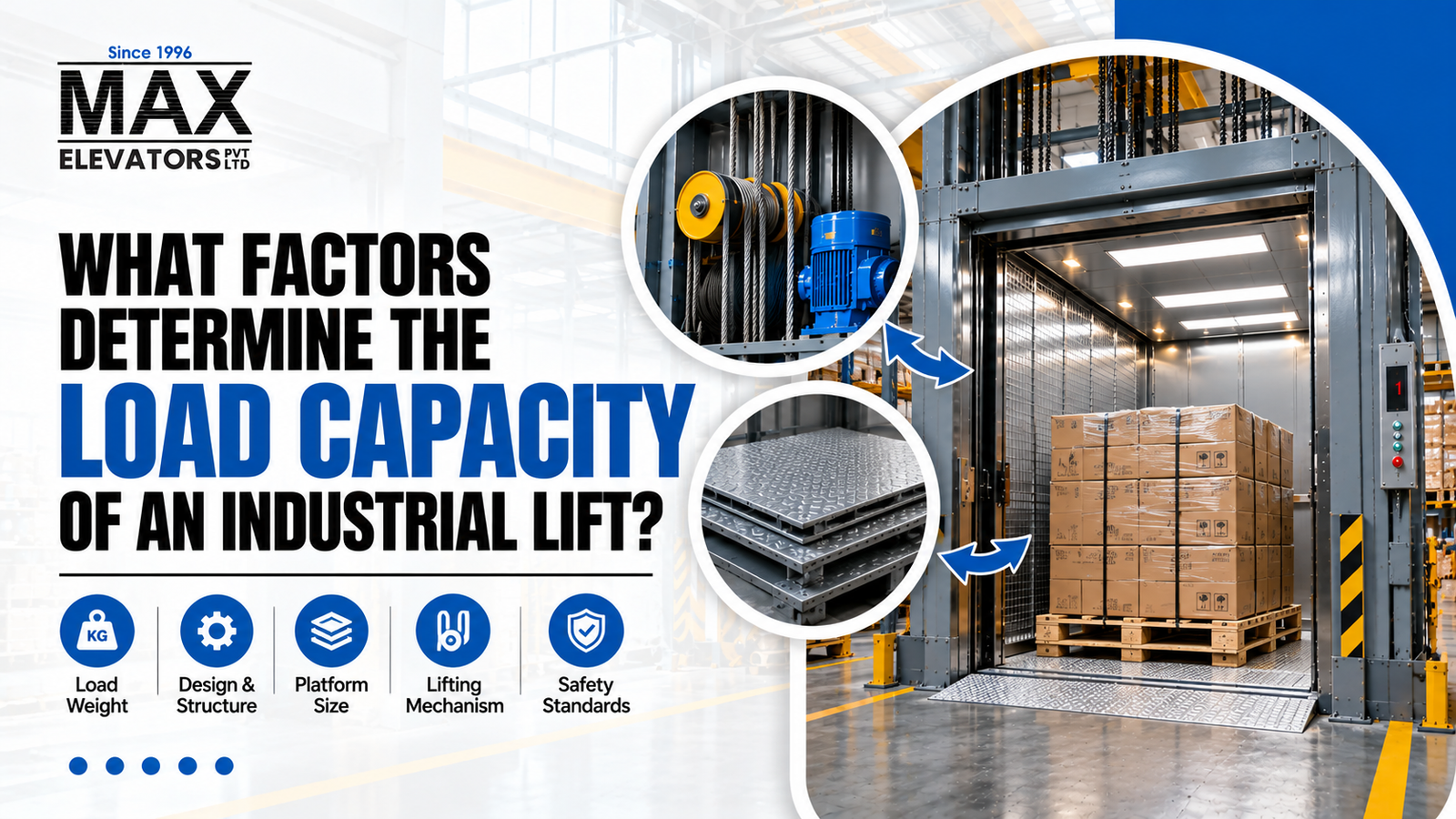
This is where industrial lift load capacity becomes more than a simple weight specification. The maximum load an industrial lift can handle depends on several engineering factors, including the weight and dimensions of the cargo, load distribution, platform strength, lifting mechanism, and travel height.
Understanding these factors helps factory owners, warehouse managers, and industrial operators select a lift that can handle their daily material-handling requirements safely and efficiently.
Let's explore what determines the load capacity of an industrial lift and what businesses should consider before choosing one.
What Is the Load Capacity of an Industrial Lift?
The load capacity of an industrial lift refers to the maximum weight it is designed and rated to lift or transport safely under specified operating conditions.
It is generally expressed in kilograms (kg) or metric tonnes (MT). For example, a lift rated at 2,000 kg has a maximum rated load of 2 tonnes, subject to its approved operating conditions.
Industrial lifts are used in manufacturing plants, warehouses, factories and commercial facilities to move heavy materials, machinery, raw materials and finished products between different levels.
However, the rated capacity is not determined by weight alone. Engineers consider how the load interacts with the lifting platform, supporting structure, and mechanical components throughout the lifting cycle.
8 Key Factors That Determine the Load Capacity of an Industrial Lift
An industrial lift's load capacity depends on more than the total weight of the materials being transported. Engineers consider the following eight factors to determine the appropriate capacity and design.
1. Total Weight of the Load
The total transported weight is the starting point for determining industrial lift capacity.
It may include:
- Cargo: Machinery and raw materials.
- Pallets: Containers and packaging.
- Trolleys: Handling equipment.
- Operators: If the lift is designed to carry them.
A 900 kg load transported on a 100 kg trolley creates a combined payload of 1,000 kg. The manufacturer must assess the loading conditions and confirm the appropriate rated capacity.
2. Load Distribution and Weight Concentration
How weight is distributed across the platform affects the forces acting on the lift.
There are three types of load:
- Uniform load: Weight is spread across the platform.
- Point load: Weight is concentrated in a small area.
- Uneven load: Weight is distributed irregularly.
A 1,000 kg machine with four small support points can create greater local stress than one with a wide supporting base.
Engineers assess the centre of gravity, load positioning and concentrated pressure to ensure safe operation.
3. Platform Size and Structural Strength
The platform must accommodate the cargo while supporting its weight safely.
Key considerations include:
- Platform length and width.
- Material thickness and strength.
- Supporting beams and reinforcement.
- Frame design and structural connections.
A larger platform does not automatically provide greater load capacity. Its structure must be engineered for the intended load.
4. Lifting Height and Travel Distance
The vertical distance a lift needs to cover influences its engineering requirements.
Engineers consider:
- Total lifting height and number of floors.
- Guide rail specifications.
- Supporting structure.
- Drive system requirements.
- Stability during movement.
The effect on rated capacity depends on the lift configuration and structural design. Capacity and travel height must therefore be evaluated together.
5. Type of Lifting Mechanism
The lifting mechanism determines how the platform moves and supports the intended load.
Common types include:
- Hydraulic lifts: Use pressurised fluid and cylinders to raise the platform.
- Traction lifts: Use motor-driven ropes and pulleys for vertical movement.
- Chain-driven lifts: Use engineered chains and mechanical components to lift materials.
The selection depends on load requirements, travel height, operating frequency and installation conditions.
A powerful motor alone does not determine lifting capacity. The complete lifting system must be designed to handle the specified load.
6. Loading Method and Dynamic Forces
The way materials enter and leave the lift affects the forces acting on its platform.
Engineers consider:
- Manual loading and unloading.
- Trolley and pallet truck movement.
- Forklift entry, where permitted.
- Impact during loading.
- Acceleration and deceleration forces.
A loaded trolley moving onto a platform can create additional impact forces compared with a stationary load placed carefully.
These operating conditions must be considered when selecting industrial lift capacity.
7. Building Structure and Installation Conditions
The building must safely accommodate the industrial lift and its supporting loads.
Important factors include:
- Foundation and floor strength.
- Guide rail mounting and anchoring.
- Structural support arrangements.
- Available installation space.
- Pit and overhead requirements.
A site assessment helps engineers determine whether the existing building can support the proposed lift installation.
8. Safety Components and Engineering Standards
Safety systems help protect the lift, its operators, and transported materials.
Essential provisions may include:
- Overload protection: Helps prevent operation beyond rated capacity.
- Door interlocks: Prevent unsafe operation when doors are unsecured.
- Limit switches: Control permitted travel limits.
- Emergency stop: Allows operation to be stopped during emergencies.
- Braking systems: Help control and secure lift movement.
- Guide rails: Maintain the platform's guided movement.
Engineers must also consider applicable Indian regulations, technical standards and component-specific safety factors.
Safety features do not permit overloading. The lift must always operate within its manufacturer's rated capacity.
How Is Industrial Lift Load Capacity Calculated?
Industrial lift capacity is determined through engineering assessment.
Basic Payload Calculation:
| Total Payload = Cargo Weight + Pallet Weight + Handling Equipment Weight |
Example:
- Industrial machine: 1,200 kg
- Pallet: 100 kg
- Transport trolley: 150 kg
Total Payload = 1,450 kg (1.45 tonnes)
However, the final rated capacity of a lift also depends on:
- Load distribution and concentrated forces
- Dynamic loading and impact
- Platform and structural strength
- Lifting mechanism specifications
- Applicable safety factors and standards
What Happens If an Industrial Lift Is Overloaded?
Operating an industrial lift beyond its rated capacity can create serious mechanical and workplace safety risks.
Potential consequences include:
- Excessive stress on the lifting mechanism.
- Platform deformation or structural damage.
- Increased wear on mechanical components.
- Hydraulic system strain or malfunction.
- Braking and control problems.
- Unsafe lifting or unexpected equipment failure.
Overloading can also increase maintenance requirements and cause operational downtime.
Businesses should follow the manufacturer's rated capacity, loading instructions, and inspection recommendations. Overload protection should be treated as an additional safety measure, not a substitute for correct load planning.
How to Choose the Right Industrial Lift Capacity for Your Business
Follow these steps to identify the right industrial lift for your facility:
01
Identify Maximum Load
| Calculate cargo, pallet, and equipment weight. | ↓ |
02
Measure Cargo Dimensions
| Check length, width, and height. | ↓ |
03
Determine Loading Method
| Manual handling, trolley, or forklift. | ↓ |
04
Calculate Travel Height
| Identify floors and vertical distance. | ↓ |
05
Assess Usage Frequency
| Estimate daily lifting cycles. | ↓ |
06
Inspect Installation Conditions
| Check space, foundation and building structure. | ↓ |
07
Confirm Safety Requirements
| Identify required safety features and standards. | ↓ |
FINAL STEP
Consult an Industrial Lift Manufacturer
| Get a lift capacity recommendation based on your actual requirements. |
Choosing the right capacity helps improve workplace safety, prevent equipment stress, and ensure reliable material handling.
Max Elevators: Industrial Lifting Solutions for Your Business Needs
Selecting the right industrial lift capacity involves more than calculating the total weight of your materials. Load distribution, platform strength, lifting height, operating conditions, and safety requirements must all be considered to ensure reliable performance and safe material handling.
Max Elevators offers industrial lifting solutions tailored to your business requirements, helping you identify suitable lift configurations based on load capacity, platform dimensions, and installation conditions.
Whether you need to move heavy machinery, raw materials, or finished goods, choosing the right industrial lift starts with understanding your operational needs.
Looking for an Industrial Lift for Your Facility?
- Discuss your industrial lift load capacity requirements.
- Explore suitable customised industrial lift configurations.
- Get expert guidance on platform dimensions and installation.
Contact Max Elevators to find the right Industrial lift manufacturer in Delhi for your business.
Frequently Asked Questions
1. What determines the load capacity of an industrial lift?
Load weight, weight distribution, platform strength, lifting mechanism, travel height, and structural design determine an industrial lift's load capacity.
2. How is industrial lift load capacity calculated?
It starts with the combined weight of cargo, pallets, and handling equipment. Engineers then assess load distribution, dynamic forces, and structural requirements.
3. Does platform size affect lift capacity?
Yes. Platform dimensions and structural strength influence how weight is supported and distributed.
4. Can an industrial lift carry uneven loads?
Yes, if it is specifically designed and rated for that loading arrangement. Uneven loads can create additional structural stress.
5. Does lifting height affect industrial lift capacity?
Yes, it influences mechanical and structural design requirements. Its effect on rated capacity depends on the lift configuration.
6. What happens if an industrial lift is overloaded?
Overloading can damage structural and mechanical components, increase wear, and create serious safety risks.
7. Which industrial lift is suitable for heavy machinery?
The right lift depends on machinery weight, dimensions, loading method, travel height, and installation conditions.
8. Can industrial lifts be customised for different load capacities?
Yes. Industrial lifts can be customised according to load requirements, platform dimensions, lifting height and operational needs.
9. What safety features should an industrial lift have?
Common safety features include overload protection, door interlocks, limit switches, emergency stops, and suitable braking systems.
10. How do I choose the right industrial lift capacity?
Calculate your maximum transported load, measure cargo dimensions, and consult a manufacturer for an application-specific capacity assessment.
Looking for Custom Lift Solutions?
Get in touch with Max Elevator engineers for expert consultation and quotes.


