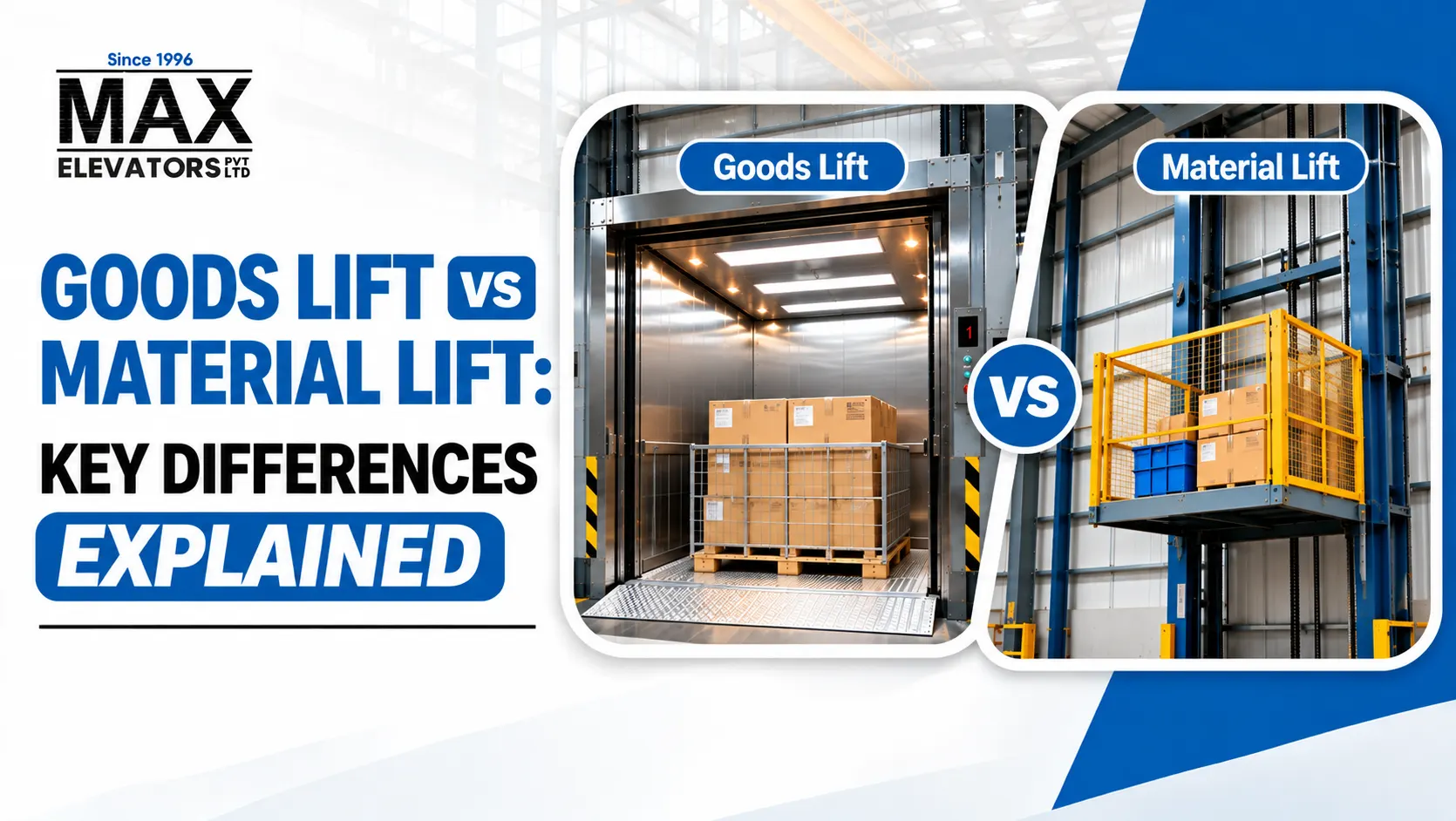
When upgrading vertical transportation in a warehouse, factory, or commercial facility, the terms goods lift and material lift are frequently used interchangeably. While both systems move heavy loads between floors and eliminate the risks of manual lifting, choosing the wrong one can lead to costly civil modifications, workflow bottlenecks, or serious safety compliance issues.
Understanding how goods lifts and material lifts differ in design, rider rules, installation requirements, and duty cycles ensures you invest in equipment that fits your actual operations.
What Is a Goods Lift?
A goods lift is a permanent vertical transport system engineered to move heavy cargo, palletized stock, trolleys, and industrial equipment between floors. Commonly installed in multi-story manufacturing plants, logistics hubs, shopping malls, and commercial kitchens, goods lifts are built with rugged enclosed cabins, reinforced flooring, and heavy-duty doors designed to withstand impact during loading and unloading.
Goods lifts operate using either hydraulic or electric traction drives. Depending on the approved design and regional regulations—such as the IS 17900 series in India—a goods lift may be strictly cargo-only, or it may be engineered and certified as a goods-passenger (or freight) lift that permits an authorized attendant to ride alongside the load.
Read More: How Does an Industrial Lift Work? A Complete Guide
What Is a Material Lift?
A material lift (also referred to as a material handling lift, Vertical Reciprocating Conveyor, or mezzanine lift) is designed exclusively for moving cargo-never people. Typically constructed with single-mast, double-mast, or self-supporting cage frames, material lifts are widely used to connect ground floors with mezzanines, storage racks, and intermediate production levels.
Because personnel are strictly prohibited from riding on the platform, material lifts are generally governed by material-handling and conveyor safety standards rather than full passenger elevator codes. Most models use hydraulic power and require minimal building work, making them a popular, cost-effective choice for retrofitting existing warehouses.
Goods Lift vs Material Lift: Quick Comparison
| Feature | Goods Lift | Material Lift |
| Primary Use | High-volume, multi-floor cargo transport | Point-to-point cargo transfer (e.g., mezzanines) |
| Rider Allowance | Cargo-only, or authorized attendant if certified | Strictly prohibited (materials only) |
| Civil Requirements | Often requires a dedicated shaft, pit, and headroom | Minimal pit (100–300 mm) or surface ramp; self-supporting options |
| Drive Mechanism | Hydraulic or geared/MRL electric traction | Primarily hydraulic or electric chain/wire-rope hoist |
| Travel Height | Low- to high-rise multi-story buildings | Typically 2 to 4 levels (under 18–20 meters) |
| Duty Cycle | Moderate to heavy continuous daily cycles | Low to moderate intermittent cycles |
| Capital Cost | Higher equipment and civil construction cost | Lower upfront investment and faster installation |
Read More: 5 Ways Lift Manufacturers in Noida Deliver Safe Mobility
5 Key Differences That Impact Your Facility
1. Rider and Operator Rules
The sharpest boundary between the two systems is human occupancy. A material lift is strictly a people-free transfer route; controls are mounted outside the enclosure so operators never step onto the platform during travel. By contrast, if your workflow requires an operator to accompany fragile stock or heavy equipment between floors, you must specify a goods-passenger or freight lift explicitly designed and certified for that purpose.
2. Civil Work and Space Footprint
Full traction goods lifts usually require structural hoistway walls, adequate overhead clearance, and a deeper pit to house counterweights and buffers. Material lifts simplify installation dramatically. Many hydraulic and wall-mounted models use a modular self-supporting structure and need either a shallow pit or a simple entry ramp, avoiding major excavation in leased or existing buildings.
3. Travel Height and Duty Cycle
Hydraulic material lifts perform best across two to four floors with moderate speeds (around 0.15–0.5 m/s) and intermittent usage. If your facility spans five or more floors or runs continuous dispatch shifts all day, a traction goods lift delivers faster travel speeds, stronger repeated-cycle durability, and lower energy use per trip.
4. Safety Architecture
Both systems prioritize operational safety through interlocking landing gates, overload sensors, limit switches, and emergency stop buttons. However, enclosed goods lifts built to full elevator standards incorporate additional safeguards—such as light curtains, overspeed protection, and fire-rated landing doors—to meet stricter building and fire codes.
5. Loading Methods and Automation
Material lifts handle standard pallets, crates, and trolleys efficiently and can even integrate with PLC controls for automated warehouse transfers. Heavy-duty goods lifts go further, accommodating high concentrated wheel loads from pallet jacks or forklifts driving directly onto the cabin floor during loading.
Read More: What Factors Determine the Load Capacity of an Industrial Lift?
How to Choose the Right Lift for Your Operation
Before requesting quotes, map out four operational realities rather than picking a tonnage figure alone:
- Calculate total dynamic load: Combine your heaviest cargo with the weight of any pallet truck, trolley, or forklift entering the platform—plus an attendant if permitted.
- Size the platform first: Base internal dimensions on your largest pallet footprint and door clearance, including whether you need single-side or through-loading access.
- Audit site constraints: Measure exact floor-to-floor height, available headroom, and whether pit excavation is structurally possible.
- Match the drive to shift volume: Choose a hydraulic material lift for compact, low-rise mezzanine transfers, and step up to an enclosed traction goods lift for high-frequency, multi-story industrial dispatch.
Selecting between a goods lift and a material lift comes down to aligning engineering with daily workflow. When your load profile, building structure, and safety requirements dictate the specification, you avoid overpaying for unused capacity while keeping your vertical supply chain fast, compliant, and dependable.
Looking for Custom Lift Solutions?
Get in touch with Max Elevator engineers for expert consultation and quotes.


